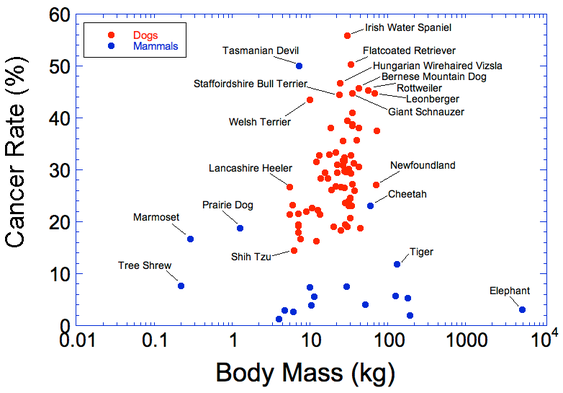
Clearly, what is considered normal for dogs is much higher than what we see in mammals in general and cancer rates that are "abnormally high" in dogs are actually off the charts. I think dogs have much to tell us about this awful disease if we back away from addressing it as a breed problem resulting from genetic bad luck, and instead see it as evidence that there
might be some unknown but fundamental process that is driving the risk of cancer in dogs.
Think: modern veterinary medicine, a poisoned terrain, vaccines and flea and tick products. Did you know that the Rabies vaccine carries several different cancer viruses?
OUTSIDE THE CANCER CELL
Our internal police force uses markers to identify unhealthy cells. The most powerful aspect of this police force is the Natural Killer (NK) cells. Normal cells have a
particular ID card and the NK cells wander around the body, policing the cells by demanding ID cards and then, if those ID cards aren't up to snuff, sorting out and executing those cancer cells.
Many cancer cells are handled this way, but there are those that can forge their ID cards and appear to present
proper identification.
Helper T cells do a more thorough check of the cancer cells and then release cytokine messengers if something is awry. They not only check the ID of the cell... they make the cell pass a lie detector test. The best way to help the Helper T cells find the culprits is to stress the
cancer cell so much that their ability to hide from the immune system is impaired. This, in some cases, can be helped with Fenbendazole.
Fenbendazole (You may know it as Panacur or SafeGuard- for intestinal
worms.)
We’ve all been using this to worm our dogs, putting a powder in their food for 3-5 days to kill intestinal worms.
Amazingly, it has multiple effects against cancer cells.
Importantly, it activates the cellular suicide of abnormal cancer cells and bursts them apart (called apoptosis).
Fenbendazole also destabilizes the microtubules of the cell, essential to cell division. Importantly, it disrupts the cancers energy production by both blocking the breakdown of sugar and blocking the ability of mitochondria to make ATP. ATP is the energy source of all cells.
Some types of cancer appear to be affected by fenbendazole, going into metabolic disruption followed by emitting cellular stress signals. This then activates the NK cells and/or Helper T cells to ID them and kill them.
It's important to know that the game is to stress the cancer cell
enough so that it cannot hide under a false identity anymore and making it easy for the policing cells to find and ID them.
When some of the tumor cells are destroyed, their bits and pieces (called antigens) are released, and nearby immune cells will get activated and thereafter will be better able to detect the
cancer cells that have been hiding.
That said, research has indicated that fenbendazole -while it works great in the gut for parasites- is rather poorly absorbed by the gut.
Fenbendazole needs to be used in the correct combination with several other cancer cell destabilizers.
Below is a site in which you can put in the species and weight and get a protocol for fenbendazole, which, by the way, is available over the counter with no script needed at 1800 pet
meds.
The next newsletter in this series will be on the topic of why I like ivermectin along with some interesting information on how it acts as a cancer protector in dogs.