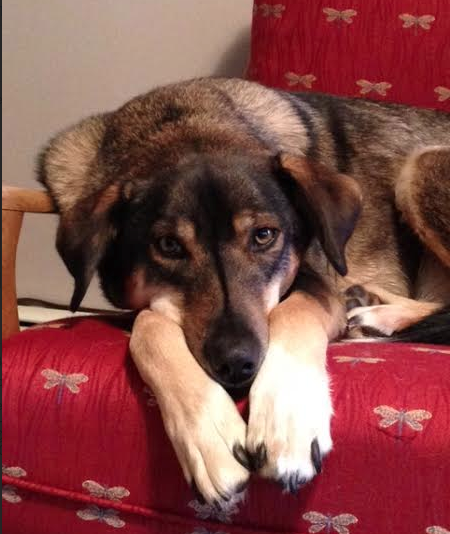
Her owners did not have an air-conditioned car, and it was a hot summer’s day. I evaluated the situation and concluded that there was nothing I could do to help her condition—something I explained to the owners as Gretchen listened. They were very worried about taking her home in the hot car, as her temperature was already quite elevated
due to the seizures. As Gretchen looked at me, we seemed to make a telepathic connection as the images of three young children suddenly flashed across my mind. I asked the owners if they had any children at home. “Yes,” they replied, “we have three small children, and she behaves like a nanny to them.”
Tears came to my eyes as I conveyed to them what it was that Gretchen seemed to be saying—that she wanted to see the children just one more time. I explained to Gretchen that she might not make it through the hot ride home. She seemed to understand and accept that her time had come, her only concern being how the children might react and whether her loved ones would be all right without her watchful eye and constant devotion. The Gift of a Golden Twilight As with all veterinarians, there have been times when people have brought their pets to me, convinced that it is time to end
their suffering. Often, the whole family will show up, emotionally distraught. I know that they have gone through hours, perhaps days or even weeks, of heart- wrenching decision making and have finally prepared themselves to face this difficult and dispiriting decision. But sometimes, when I have looked at the dog whose fate seemed to have been decided, I will notice a certain brightness still residing in his eyes, reflecting the tenacity to hang on to life despite the distress and pain of the
affliction. While I know it would be
much easier for the family at that point to simply end the ordeal, as a healer of animals I feel obligated to convey to them what I sense to be the dog’s viewpoint. In such instances, I will quietly tell them, “It
is not yet his time. He is not ready to go now.” Their eyes willbrighten up as well, and they will look at the dog as if to say, “OK then, you continue to hang in there with us, buddy, and you tell us when your time has
come.” The special kind of love that they have had between them for years becomes even more powerful as they respect their pet’s desire to have perhaps just a few more cherished days with them. Many people, upon learning that their pets have only a short time left to live, have found a new perspective on
life and love. So many of the things that they had long taken for granted suddenly began to take on a precious and beautiful glow. Whether it be a sunrise or a special gift received from a loved one years ago, each experience was now savored and remembered with a heartfelt reverence. Arguments and disagreements suddenly seemed petty, and sharing love became all important. Just as that love proves to be the eternal aspect of our lives, so it is with the lives of our pets.
If anything, their depth of feeling for the families with whom they live is even purer (and more forbearing and forgiving)
than that of most people.
And because their time on earth is so much shorter than that of other loved ones, every day they spend with us is that much more meaningful. That’s why, even when a dog has been discovered to have a terminal illness, it shouldn’t necessarily be viewed as a cause to cut short his remaining days simply to “put him out of his misery.” For what may seem like a painful existence to us is likely to be mitigated for the dog by the chance to spend additional precious times with the people to whom he is so devoted—a kind of golden twilight you can give your companion as a
parting gift. Such was the case with KC, a wonderful black Cocker Spaniel I had treated for many years. I had pulled KC through a number of serious health crises. Finally, it came time for her owners to make a painful decision. She was suffering from severe heart failure, her abdomen was filled like a tight drum with fluid, and she was breathing with difficulty. I looked into her eyes, and she looked back at me.
“Not now,” she seemed to be saying. “It’s not yet her time,” I told her owners. But they were clearly worried, since they would be leaving shortly for their son’s wedding, which was to be held high atop a mountain in New Hampshire. How could they take her in such a condition? Who could they possibly leave
her with? “We’ll do whatever it takes,” I said. I proceeded to manually drain a good deal of the fluid
from her abdomen, making her breathing somewhat easier, and altered the schedule of her herbs and medications. KC not only attended the wedding on that mountain, she became the “guest of honor,” traveling in high style in a baby carriage. She knew how excited her family was over this event, and she got to be an important part of it and was part of the wedding ceremony. The quality of her life, in fact, remained good for several more months. And when the time finally came that nothing more
could be done to make her comfortable, and she was obviously failing fast, I explained it to her and sensed that she agreed. But euthanasia is not something that should simply be dictated by convenience or by the understandable desire to prevent a dog’s quality of life from diminishing as an illness progresses. Far too often, people are influenced by people who tell them that the dog should be put to sleep simply
because he does not walk as well as he used to, or that it’s better to simply get a new dog rather than to prolong the health problems of their current dog. Offensive though it may seem to some people’s sensibilities, I feel compelled to share with you a hypothetical example I often give to clients who are
torn over what to do with a dog who has been given only a short time to live. Imagine that a close relative—say, an aunt who has always been a kind, gentle, and loving person, asking little for herself— has just been diagnosed with liver cancer. Can you imagine the rest of the family coming to the hospital to tell her they have decided that she should be “put to sleep” because she has only six months to a year remaining and it would be just too painful for everyone to see her through the
ordeal? While Western theology has perpetrated the belief that only human beings are blessed with a divine spark and a spiritual existence beyond death (based on the idea that man is created in God’s image), anyone who has shared a relationship with a dog is likely to find that hard to accept. Dog owners know that the unconditional love exhibited toward us by our canine companions can be one of the most precious things in the universe—a sublime and powerful flow of energy that is about as close to divine love as any experienced on earth. And they know that a dog has a soul as pure as that of the most noble of humans. That’s why I strongly believe a dog’s affection for his master to be a form of spiritual energy that transcends earthly existence—an energy that we can call upon any time we need it, even long after our four-legged best friends have departed this life. There is another spiritual aspect of a dog’s passing that should be a source of great comfort to those left behind. Some of my own experiences have firmly convinced me that dogs and their masters can be reunited after death; this is a theme that has been reflected in both song and story throughout the ages.
Many years ago, I treated an
English Setter named Morgan who was suffering from a terminal illness. His owners preferred that he go naturally rather than be put to sleep. His condition was not particularly painful, so I concurred. They needed to work during the day, so they left him at my practice so he could be with us. His days were at my clinic, where he was comfortable and loved and he went home for the nights. A few days had passed like this. When they called one day [as usual] to see how he was doing, I told
them that they needed to communicate with him mentally and tell him it was OK for him to go.
A while later, I returned to the kennel area where Morgan was lying on a soft
comforter. In between the stainless steel cages, I saw an elderly man with white hair and a closely cropped beard holding Morgan’s head gently in his lap and stroking him. The gentleman had a very distinctive look, with a strong jaw and the love he poured over into Morgan was palpable. When I got to the cage, however, the stranger was gone. Then Morgan let out a small sigh and peacefully passed away. I called the owners to tell them that Morgan had passed, and I described the apparent
apparition I had seen. They said little in response to my story. Two weeks later, the owners came to the clinic to pick up Morgan’s ashes. They took me aside and produced a picture of an elderly gentleman, asking, “Was this the man you saw?” Taken aback, I told them that it was indeed. “He was my father,” one of the owners said. “Morgan and he were the best of friends until my father passed away three months ago.”
|
|
|