A Spicy Slice of History
Before 2000 BC, Arab merchants controlled the
Mideast overland
trade routes to India. After sea routes were discovered, Egypt
became a major spice trading center. Later, Venice monopolized
the spice trade with the Middle East, becoming the middleman
for the rest of the Europe.
Countries became very wealthy from the spice trade.
As Venice started demanding exorbitant prices, Portugal and
Spain looked eastward for new routes and then, with the voyage
of Christopher Columbus, searched westward.
Columbus wasn’t looking for America; gold took a back seat to spices. He was looking for a shorter ocean route to
India, to gain faster access to their spices.
Herbs, during these times, were not simply flavorings. Herbs
and spices were all that was available medicinally to heal. The great
value placed on
spices was due to their healing properties, making
herbs sometimes more valuable than gold in commerce.
Each region had plants and herbs that were specific to that
particular area and climate.
Countries were motivated to discover
and control new routes for spice trade because these herbs were
precious.
Spices were big business.
For centuries, what was acceptable in the field of healing depend-
ed on when and where you lived, and what was available. For
instance, there
were times in our relatively recent history where
using herbs was punishable by death and the women that used
them to heal others were branded witches. Nostradamus was
a
favorite of Queen Catherine de Medici. Otherwise he would
have burned on the cross for curing the plague with rose hips. In
those days, a doctor who could cure diseases that his colleagues
could not was considered to be in league with the devil. Interest-
ingly, at the time Nostradamus went to medical school, doctors
studied astrology. The astrological configuration when the pa-
tient contracted the disease was an important factor in choosing
the treatment. Nowadays, this would be considered poppycock.
Instead the pharmaceutical companies control what we think by
spending fortunes on advertising, while decrying natural healing.
TIMES HAVE CHANGED
Pharmaceutical drugs are not designed to cure. The manufactur-
ers need you to keep refilling your prescription every month so
they can increase their profits.[Say this to yourself three times over and then think of all the flea and tick preventives and
unneeded vaccines}
In ancient China, a doctor was paid when the patient was healthy. If the patient became ill, the doctor didn’t get paid; but he was expected to spend his time and knowledge to return the patient to health. Imagine how this payment plan would change the practice of medicine today!
Each culture had its particular sacred and common
herbs. Over
time, just about all have been shared throughout the world. We
can now go into a health food store and buy herbs that were more
precious than gold hundreds of years ago. The World Health Or-
ganization estimates that about 80 percent of the world’s people
rely on herbs for healthcare today. [Stunning fact... isn't it?]
Nowadays we need herbs even more because the majority of
our food sources are grown on depleted topsoil. The produce on
the supermarket shelf lacks the nutrients that our cells need
to thrive. Farmers have resorted to mass-produced agriculture,
applying fungicides, pesticides, and tons of fertilizer. These
chemicals bring an empty harvest, devoid of nutrition. Spices and
organic food provide a full harvest for the body. Spices are actually
foods, so the body recognizes their nutrients and uses them to
promote
health. They provide a multitude of balanced vitamins
and minerals from nature; they’re easily absorbed and they help
replace the body’s missing nutrients and balance cells.
A GARDEN FOR THE WHOLE FAMILY
As with most healthy food sources, what’s good for us is good for
our dogs. You can easily add spices to cooked or even raw meals
for your dog. To bring out the full flavor and health benefits, add
them to home-made cooked food. They produce a wonderful fra-
grance and impart a special touch. Fresh spices, of course, have
greater
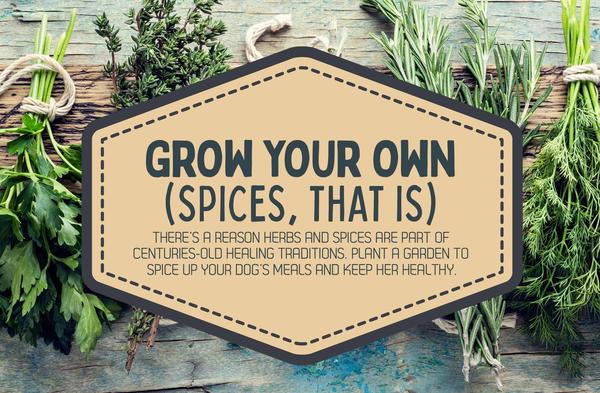
healing properties than dried. I have a kitchen garden
where I grow herbs and many of them are perennials that return
again in the spring.
Growing a healing herb garden for both you and your
pets is
healthy in so many ways. Working in the garden, next to happy
thriving herbs, is a tonic in itself and fresh herbs have benefits
that are often superior to dried herbs. The fun part is deciding
what to plant.
So, here are some of my suggestions.