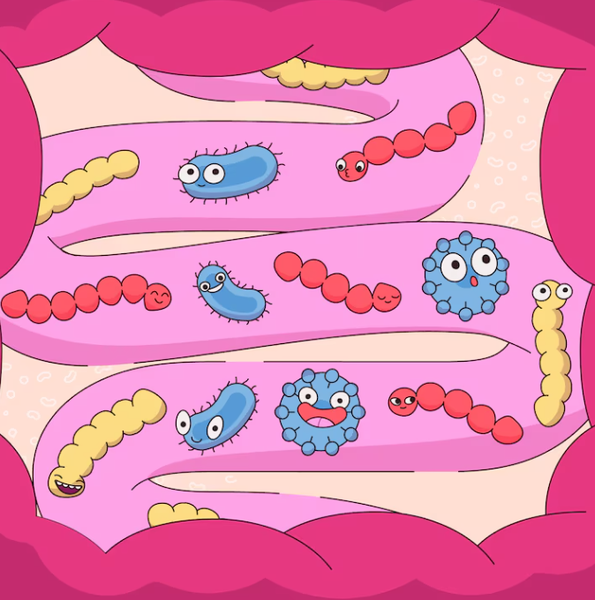
The Digestive Tract Has A Microbiome
Over the past several decades, the frequent use of antibiotics in both pets and people has detrimentally altered their internal microbiome.
These alterations continued throughout generations... generation after generation.
The gut flora is the foundation of the immune system. Modern lifestyles alone have totally changed the composition of this flora in both humans and pets. Primitive people studied in Brazil who have never taken antibiotics nor consume sugar, white flour and processed foods have a very different composition of friendly flora in their gut.
Over half of stool is made up of bacteria. These gut bacteria play a huge part in health of the body.
The gut flora is the foundation of the immune system.
One might
even call the gut flora the canary in the coal mine.
Many pet owners send a fecal sample to a GI laboratory for analysis, figuring they will figure it all out and be able to supplement their pet with the 'missing bugs'.
It's important to know that these tests are very iffy.
In fact, if the same sample is sent to 6 different GI microbiome analysis labs, you will find you get 6 completely different sets of results.
Most folks simply give
probiotics day after day, week after week, month after month figuring that this will help.
The question is: is this course of action actually helping?
Let’s take a bird’s eye view of this. If these are live
bacteria should they not seed the intestine with their progeny after a week or two and be able to be discontinued?
Would you plant garden seeds day after day and keep on doing it for years if they didn’t grow?
Why do probiotics need to be given every day for the life of the dog?
What’s the story here?
To begin with, pet owners are exposed to an incredible amount of advertising as are their veterinarians.
Research indicates that anywhere from 80-99% of traditionally used probiotic cells will be killed off by stomach acid before reaching the intestine. If the good bacteria are to provide their beneficial effects, they must be able to survive the journey in the stomach in numbers high enough to allow them to do their jobs. Add to this that the vast majority [if not all] of the probiotics you purchase are dead in the bottle. There are formulators for probiotic companies that say they
cannot get them to last on the shelf in the store for more than 6 months.
It’s destined to fail.
It has been admitted that the vast majority of probiotics are already dead in the bottle when you purchase them.
Of whatever MIGHT
be left alive, at least 80% are killed by the HCL acid in the stomach.
There are thousands of strains of bacteria in the gut. Therefore, maintaining the gut flora becomes a complicated and very confusing job.
The strains present
in probiotic formulations vary widely and each formula contains only a few of those strains.
Some strains of probiotic bacteria, such as the Bifidos, are stronger bacteria- returning without any help at all after a course of antibiotics.
Again... there’s the question of whether probiotics (if they are still alive when you purchase them) actually ever make it to the gut as the HCL in the stomach kills them.
Yet…..you’re purchasing probiotics and giving them every day. And many of us wonder why they don’t do much.
PREBIOTICS
Prebiotics are more important than probiotics as they provide the nutrition the good bacteria need to survive and thrive.
Simple green vegetables and herbs like dandelion,
artichoke, garlic and asparagus are all excellent prebiotics.
Pectin is also a prebiotic. Think - “An apple a day keeps the doctor away.” Prebiotics are defined as: selective ingredients that result in specific changes in the composition and activity of the gastrointestinal microbiota, thus conferring benefits upon host health.
In short, they help the good bacteria in the gut to
grow.
It's been said, and I agree, that prebiotics are TEN TIMES more powerful than Probiotics in improving gut health.
We can conclude that prebiotics
are a really good for the gut and healthy to boot!